
Tsunami Diffusion Array
An undersea megathrust earthquake is unleashed by subduction on the pacific rim. One of many possible locations. Rapid movement of the the sea floor generates enormous tidal forces. Tsunami, lined up like the surges of an invading army, bear down on the heavily populated coastline of the nearby countries. People remain calm, about their business, as the looming destruction approaches.
From high above we see the waves ripple across the ocean surface toward land. A shimmer of energy streaks up the horizon. A barely visible force shield appears. The tsunami slam the wall as it absorbs all the energy, leaving the shore unaffected.
In some far off future this might be how civilization defends itself from such great forces of nature. The real question is what options are available for defending populated coasts at such risk now.
The Tsunami Diffusion Array (TDA) concept initially came to me while sitting on the beach near Malibu, California. I watched the waves roll into the rocks on shore. The tide was coming in.
Fatigued from long days, I was caught looking down for a moment. My attention was quickly brought to an approaching wave bigger than the previous ones. Big enough, moving fast enough, that it looked like I was going to get a little wet.
My body clenched a bit, but nothing.
To my surprise, as the wave moved over a rock formation only a fraction of the wave height, it completely dispersed the energy. So much that it did not even touch my feet. This peaked my curiosity.
A quick look at the rock formation from the top made me realize what was happening, a form of diffusion. The rock on the beach had eroded in a manner that formed about five staggered - or offset - rows of columns. Each column with a rough isosceles/equilateral triangle shape, the pointed-end directed into the ocean like an arrow.
They appeared to possibly be formed from the water washing around over time, with different sediments eroding at different rates.
This rock formation made the perfect mechanism to divide and channel the wavefront into itself.
The row of columns created a series of divisions in the water current. Each channeled current angled toward the neighboring one. The impact of the two currents dissipates the wave's energy. The remaining current wash keeps moving toward the next row. As illustrated in Figure 1, the repeated rows and staggered formation amplify the process.
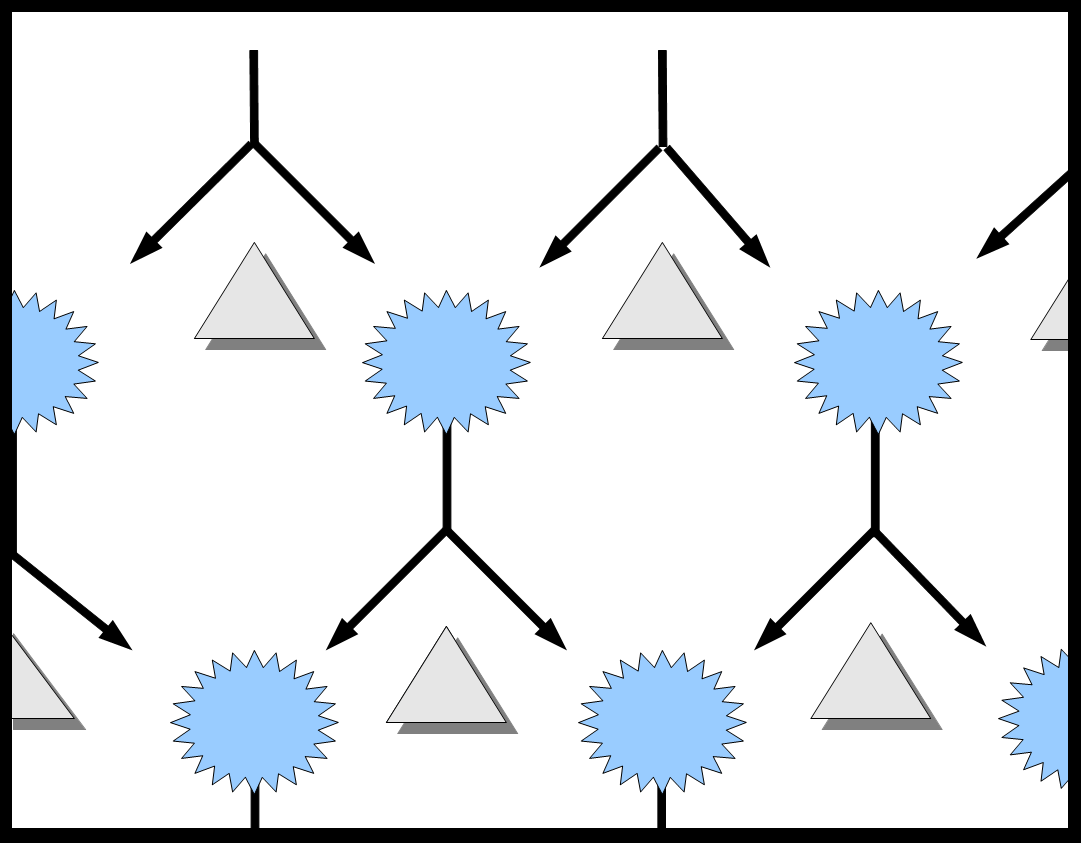
Despite being less than half the size of the wave, this naturally occurring rock formation significantly diminished its energy. These were not curled waves. Rather a flat wave, more analogous to a tidal surge. The shear volume of energy dissipated was astonishing. The water was about 60cm deep, rock columns rising about 45cm above that. The surge approached at about one meter above the standing water level. The speed estimated at 19-24 kph. The entire surge, with help from the natural shore slope, was dissipated in less than 4m.
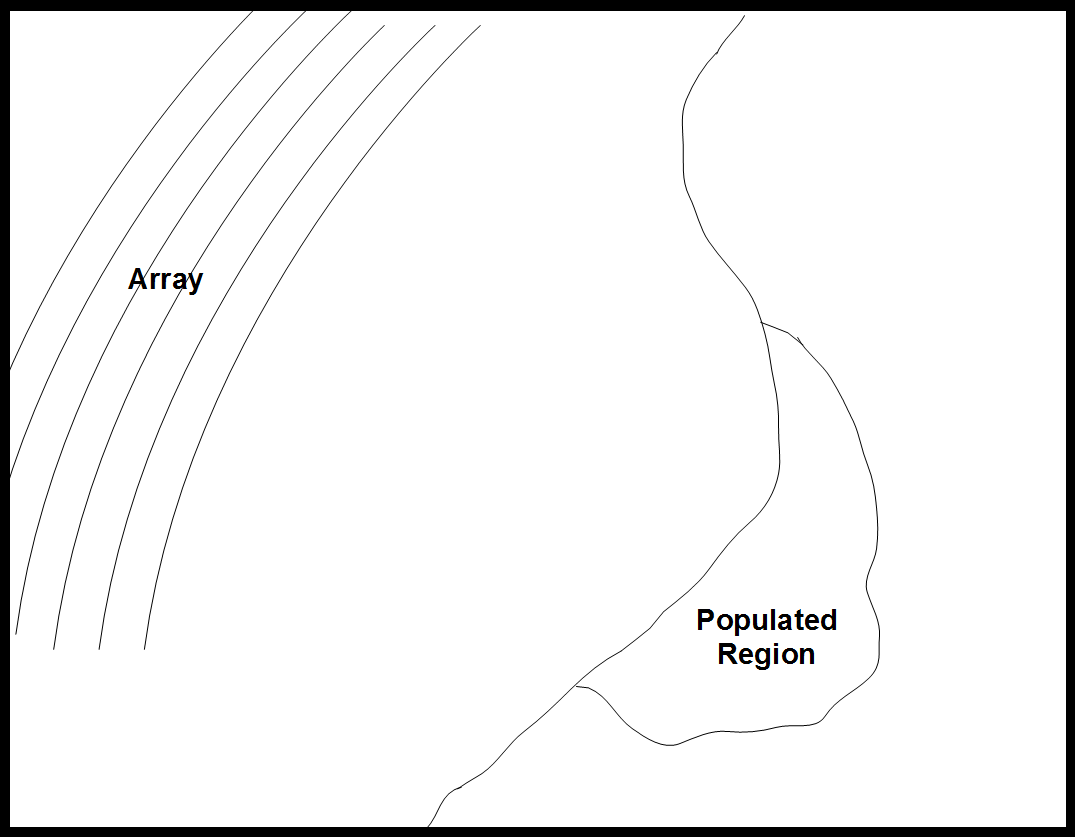
TDA design and placement would vary some due to factors such as, but not limited to, the shape and size of the continental shelf, tides, wildlife, shipping lanes, and desired coverage. Each array would still be of the same basic underlying concept and structure though. A series of “channeling towers”. Each row of towers would be offset from the last in a staggered patten. The entire array would form a slight crescent - or shield - shape bowing out to the sea. The bow can be seen from top-down in Figure 2. Though placement may differ, curves may change.
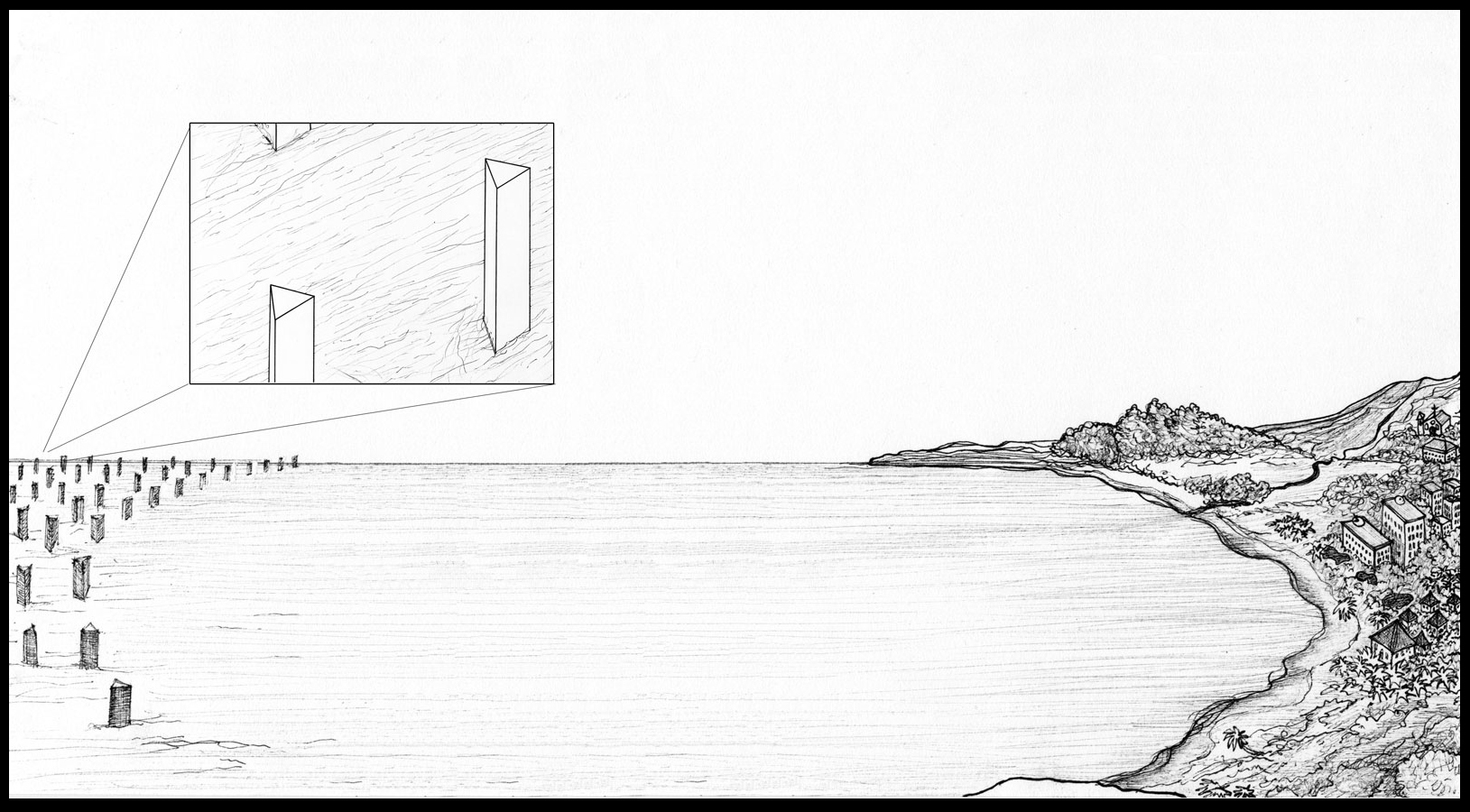
The height of the channeling towers are assumed to be proportionate to roughly half the size of the tidal waves intended to diffuse. However, further research and improved efficiency may yield different ratios. The shape of the tower may resemble a slice of pie, or a section of a round column cut from the center point. The pointed-end facing to sea to begin the current division. The round backside to minimize wind resistance. The steepness of the angle would depend on the desired channeling direction, and the strength of the column itself to resist the tidal force. A flared edge and other features could be used to optimize current flow. The tower top could be designed in various aerodynamic forms. From a simple domed top to a fin-like blade.
In a perfect implementation, one still requiring many more years technological advancement, the array would be retractable to the seafloor, or below the sea level. Built of super strong nanomaterials, such channeling towers could disappear from view and extend like a radio antenna for protection. Maybe the array is automatically alerted by early warning buoy systems. Perhaps each tower moves using electromagnetism and superconductive properties.
Long-term underwater geothermal power sources may even be attainable in the most common area at threat, tectonic subduction zones. Such advanced implementation may be farther into the future. However, current construction techniques can succeed in something just as effective. If not as fancy.
A TDA construct today would most likely be of a concrete and metal construction, permanently installed channeling towers. Even this is still a much more practical method to defending a coastline compared to building seawalls or levies.
Especially considering a seawall cannot be as easily installed on many coastlines, or provide enough coverage. Ideally a TDA would use fewer raw materials to build, and would impact the coastline less.
Impact on the coast and its ecosystem was one of the first things I considered personally. How will it affect the delicate life that depends on the tide. In some high-tech, futuristic installation with telescoping towers that open and expand, there might be very little impact. However, with a permanently installed TDA there would have to be other considerations made, studies conducted.
Too close to shore and the channeling towers could negatively affect tidal life. There is potential to engineer ways around this though, like steps in a dam for migrating fish. The towers could be designed to effectively diffuse above normal water levels only. Meanwhile they remain more transparent to the current underwater. It is also plausible that on many coastlines the continental shelf would extend out, at reasonable depths, to place the array away from the daily tides. Yet it still remains capable of diffusing the tsunami current to manageable levels.
There are also public and commercial effects to take into consideration. Will people accept the site of the array off the coast? Public acceptance will be dramatically affected by implementation. For instance, the distance from shore the array is placed and spacing between the towers will affect the intrusiveness on the coastal view. It might be plausible to color them to blend with the everyday horizon better as a solution. The array could be designed to minimize the number of towers required.
What about shipping lanes? If it is not plausible to go around on a vary large scale implementation.
Perhaps a wider path could be engineered into the array at an angle. Such a modification might allow ships to move through safely, meanwhile not significantly depleting the array's desired diffusion effects.
It might even be considered to design the towers with a multipurpose. Their relative position in some cases might be ideal for wind - and/or tidal - energy generation. Though the tsunami itself could pose a risk to such equipment, the implementation on the long-run might still be quite beneficial. Communication or radar arrays, observation, even weapons platforms could all be possible ideas for additional uses.
As with many technologies, a weighing of the benefits with the disadvantages would have to be made. Much research into the design and implementation would be necessary. Engineering that would change as available resources and technology evolves. Many questions would inevitably arise. What is practical compared to the actual risk? What will be the impact on people and environment? How large a coastline portion could a TDA be built to protect?
As history has shown with many of the wonders of the world, great things can be accomplished with enough necessity and/or desire.
Original publication date: September 13th, 2011